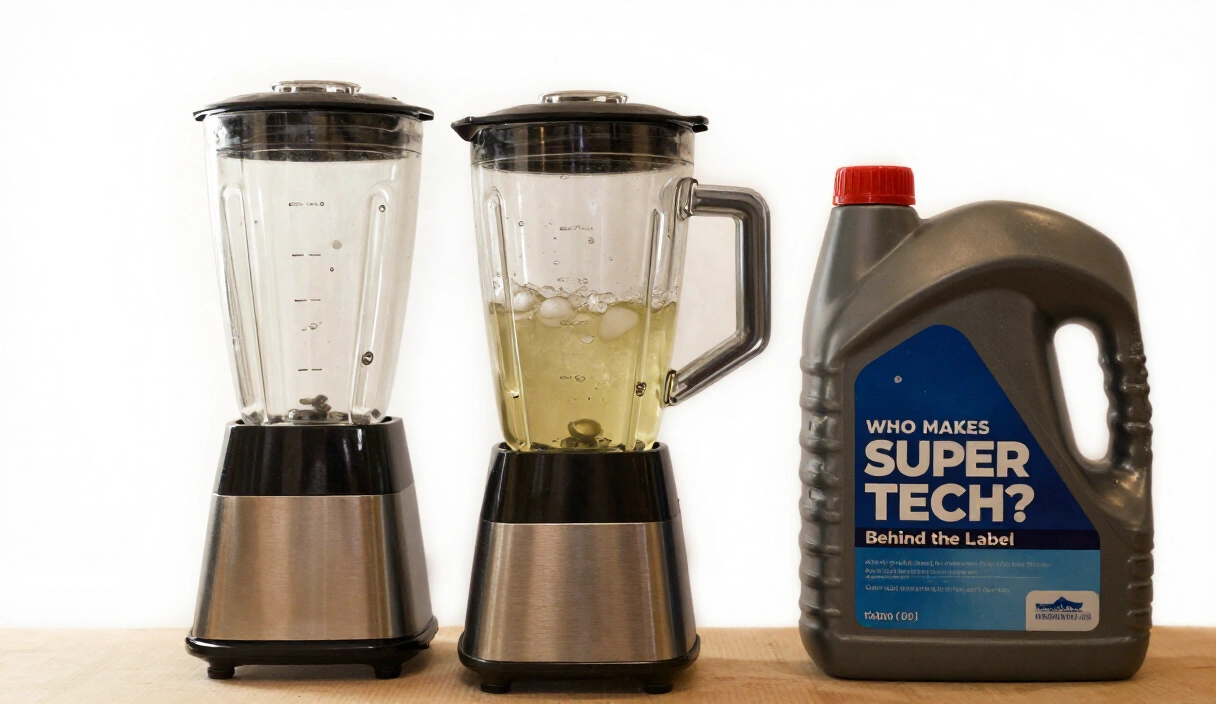
Who Makes Super Tech Oil? The Blender Behind the Label
Supertech is not made by Walmart, and not by a mystery company either. Here is the contract blender behind the jug, how to confirm it from the label, and where the oil stops being a bargain.
Contents
The answer is not “Walmart,” and it is not a secret either.
Supertech Motor Oil is a private label — a product Walmart specifies, contracts out, and sells under its own name. The company that blends and packages it is Warren Distribution, which merged with Highline Aftermarket in 2020 to become Highline Warren. That name appears on the shipping cases far more often than it appears in forum threads.
The reason this question gets 390 searches a month with almost no editorial answer is that the shelf is designed to hide exactly this. A private label exists so that the retailer, not the factory, owns the customer relationship. The factory is happy to stay invisible.
Walmart Does Not Make Oil
No retailer refines base oil, and no retailer runs a blending plant for its own house brand. That is not how the industry is structured, at any scale.
A private label works like this: the retailer writes a specification (grade, API category, sometimes an OEM approval), a contract blender tenders for it, and the winning blender produces, packages and ships it under the retailer’s brand. The retailer owns the label; the blender owns the plant, the base oil contracts and the additive purchases.
Worth knowing: The same structure produces Costco’s Kirkland Signature oil, Amazon Basics, and dozens of regional store brands. The number of actual blending plants behind the shelf is far smaller than the number of labels on it.
This is the point where the conversation usually goes wrong. People hear “store brand” and assume a second-tier product. The frustrating part is that both sides of that argument are lazy: the oil is not secretly the same as a premium brand, and it is not floor sweepings either. It is a specified product built to a price.
The Blender: Warren Distribution to Highline Warren
Warren Distribution — often called Warren Oil Company in older forum posts, which is why half the internet still uses that name — is one of the largest private-label lubricant producers in North America. In 2020 it merged with Highline Aftermarket, and the combined entity operates as Highline Warren.
What that means practically: the plant capacity behind Supertech is not a small workshop. It is a contract manufacturer whose entire business is producing to someone else’s specification, at volume, with the paperwork to prove it.
What struck me when I looked into it properly was how ordinary the answer turned out to be. There is no shadowy supplier. There is a large blender with a website, a merger history, and a customer list full of retailers you already shop at.
Two things worth being precise about:
- Warren blends, Walmart specifies. The grade and licence requirements come from the retailer’s spec sheet, not from the blender’s preferences.
- Sourcing can shift. Contract manufacturing moves between plants for capacity reasons. “Made by Warren” describes the arrangement, not a guarantee about the batch you bought in 2019.
How to Verify It Yourself From the Label
You do not have to trust an article, including this one. The jug tells you most of what matters.
1. The API donut. A licensed oil carries the API service category in the starburst — API SP for the full synthetic lines. That is a licence held against the specific product, verified through the API’s licensing system, not a marketing claim.
2. The licence text on the back. It names the licensee. For a private label, that is usually the retailer or the blender, and it tells you who is legally answerable for the formulation.
3. The manufacturer line. Bottled and packaged products name the responsible party. If the back label says “distributed by” with a city, that is the retailer; the blender appears on the case, not always on the jug.
Quick check: No donut, no licence text — then it is either unlicensed or outside the categories that require licensing. For a normal passenger-car oil, that absence is your answer.
The system is checkable if you know which three places to look, and almost nobody is told which three places to look.
What the Same Money Buys Elsewhere
Here is the honest split, and it is more interesting than “it’s just as good.”
Where Supertech is genuinely equal: a normal engine, a normal drain interval, the correct grade, a current API SP licence. The oil is tested to the same category and produced on the same class of equipment. For a Honda at 5,000-mile intervals, the difference from a $6 bottle is not observable.
Where it is not equal:
- OEM-specific approvals. BMW Longlife-04, VW 504 00, Chrysler MS-12991 and their relatives are certified per product and cost real money. Private labels tend to certify the mainstream API categories and skip these.
- Extended-drain claims. There is no store-brand equivalent of a 20,000-mile formulation, because that requires its own validation programme.
- Batch-to-batch consistency as a brand asset. A national brand has a reputation to protect across every lot. A private label is protected by contractual spec and by the retailer’s willingness to test.
If you want the product-level detail rather than the manufacturing story, the full Supertech motor oil review walks through what the certification paperwork actually says.
Filters Are a Different Company
The most common confusion in this whole topic: Supertech oil and Supertech oil filters are not made by the same company.
The oil comes from a lubricant blender. The filters came, for years and by widespread report, from a filter manufacturer — Champ Labs, now part of First Brands Group — though Walmart does not publish its supplier list and filter sourcing has changed over time. A filter plant and an oil plant have nothing in common except the label.
That matters because forum threads blend the two questions together and then argue about quality across products that share only a trademark. When you finally separate them, both answers get simple.
What This Means Next Time You’re in the Aisle
The direction of travel in this category is toward fewer, larger contract blenders and more labels on top of them. That is not a scandal; it is the same consolidation that put four parents behind most of the shelf, which who owns which motor oil brand lays out in full.
So try this at your next oil change: read the back label of the house brand and the national brand side by side. Compare the API category, the grade, and the OEM approval line. Then decide whether the logo is worth the difference — armed with the knowledge that both jugs likely came from a plant that has never once advertised.
If your car needs only API SP in the right grade, the house brand is a rational purchase and you can feel satisfied that you are not gambling. If it needs an approval the house brand does not carry, the question answers itself. For the licensing background, what API SP licensing actually covers explains what is and is not verified.
Frequently Asked Questions
Who actually makes Supertech motor oil?
Warren Distribution, operating since a 2020 merger as Highline Warren. It is a contract blender that produces to Walmart’s specification, which is why the brand is Walmart’s but the plant is not.
Is Supertech made by the same companies as name brands?
It is made by the same class of producer, buying base oil and additive packages from the same suppliers. The difference is the specification and which certifications the retailer chooses to pay for.
Is Supertech oil API certified?
The full synthetic lines carry API SP licences, verifiable from the donut on the jug and the licence text on the back. Non-synthetic and specialty lines vary, so read the specific product.
Who makes Supertech oil filters?
Not the oil blender. Filters have long been attributed to Champ Labs (First Brands Group), though Walmart does not publish suppliers and sourcing changes. The oil and filter product lines are separate contracts.
Is Supertech good enough for a newer car?
Yes if your manual asks for API SP in a specific grade and nothing more. No if it names an OEM approval — those are certified per product, and store brands usually skip them.
Related Articles
Synthetic vs. Conventional Oil: Which Do You Actually Need?
Synthetic vs. conventional oil: which do you actually need? Here's the cost-per-mile math, a 5-question decision tree, and the honest answer for your engine.
Best ACEA C3 Oils for BMW Longlife-04 (2026 Approved List)
Six BMW Longlife-04 approved 5W-30 synthetics that actually carry the LL-04 stamp — ranked by availability, price, and OEM approval depth.

How Long Does Synthetic Oil Last? Mileage, Time, and What Actually Depletes It
How long does synthetic oil last? 7,500–10,000 miles in normal driving, up to 15,000 for extended-drain formulas — but time runs independently of mileage.